

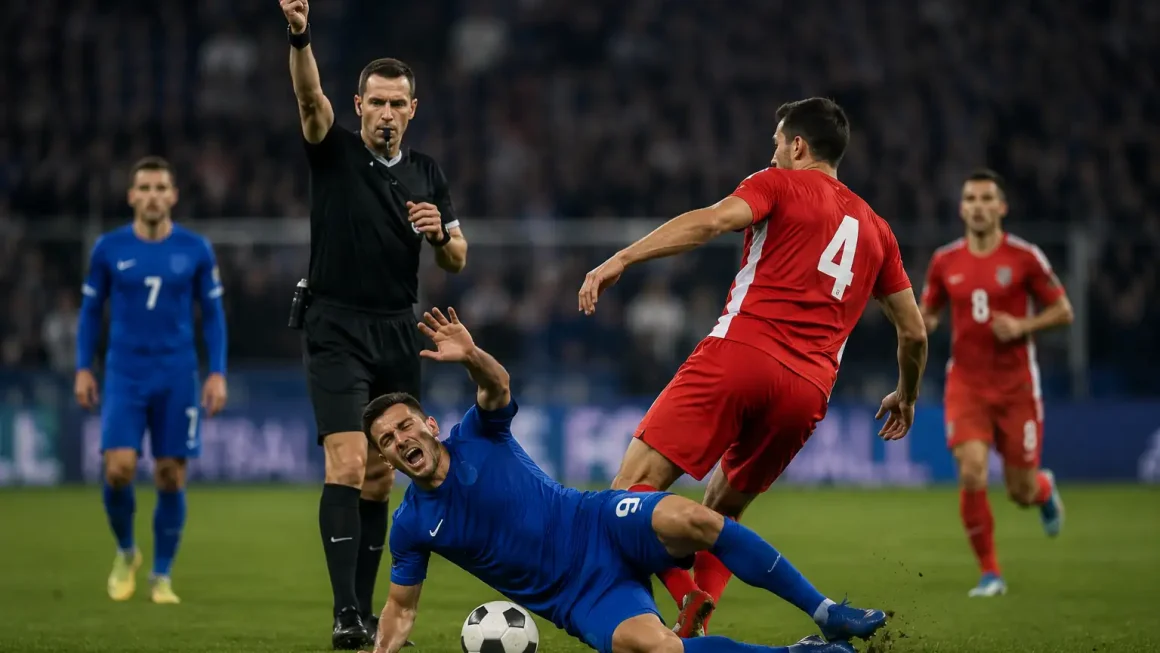
A foul is one of the most important concepts in football – it affects the course of every match, decides about free kicks and penalties, and in extreme cases ends the match for the fouling player. What exactly is a foul, what are its types and what are the penalties for specific offenses? We explain everything step by step.
What is a foul in football?
Faul to statutory offense – any play that is inconsistent with the rules of the game, disrupts its flow or threatens the safety of the players. This may be physical contact with the opponent in an unauthorized way, but also a technical play – such as intentionally playing with the hand or disturbing the goalkeeper. Importantly, the foul does not have to be intentional: the referee assesses the play itself and its consequences, not only the player’s intentions.
The decision to recognize a play as a foul is made by the referee, taking into account several factors: the force used, the player’s intentions, the situational context and the potential threat to the opponent’s health. In more serious cases – especially red cards – the VAR may intervene to verify the decision made on the pitch.
🏆 Fantasy Premier League rules – how to play and score in FPL?
What are the types of fouls in football?
The Laws of the Game divide fouls into two main categories: direct i indirect. The difference between them determines what type of free kick will be awarded to the injured team.
Direct foul this is the most common type of offense. It results in the awarding of a direct free kick – that is, one from which you can shoot at the goal without passing to your partner first. Direct fouls include:
- kicking or attempting to kick an opponent
- tripping or tripping an opponent
- jumping on an opponent
- pushing or holding an opponent
- hitting or attempting to hit
- dangerous slide – especially from the back or with a high leg
- intentional handball by a field player
Indirect foul it appears less often in matches, but has its own specificity: an indirect free kick awarded cannot be used to score a goal directly – the ball must first touch another player. Indirect fouls include, but are not limited to: dangerous play without contact with the opponent (e.g. raising the leg too high in front of the opponent), disturbing the goalkeeper during a goal kick or delaying the restart of the game.
What is the penalty for a foul in football?
The consequence of a foul depends on the type of foul, location on the pitch and the seriousness of the offense. The referee has several tools at his disposal: free kick, penalty kick or a card – yellow or red.
A free kick is the basic penalty – awarded for fouls committed outside the penalty area. Direct allows you to shoot at goal, indirect requires prior contact with another player. The team takes a shot from the spot of the foul, and the opponents must stand at least 9.15 meters from the ball (the referee can mark this distance with a quickly disappearing spray).
A penalty kick is the most severe consequence of an infield foul – awarded when the defending team commits an offense within its own penalty area. The shot is taken from a distance of 11 meters from the goal, and the only defender may be the goalkeeper.
Cards are individual sanctions for the fouling player:
- Yellow card – warning for more serious offenses, unsportsmanlike conduct, faking a foul or intentional delay of play. Two yellow cards in one match automatically result in a red card
- Red card – means immediate exclusion from the game. It may be the result of two yellow cards or awarded directly for brutal play, tactical foul (intentional interruption of an obvious goal situation) or aggressive behavior towards an opponent.
When does a foul result in a penalty kick?
A penalty kick (colloquially “eleven”) is only awarded when foul in the penalty area committed by the defending team. The penalty area is a rectangle marked with white lines around the goal – its dimensions are 40.32 m wide and 16.5 m deep. Any direct foul committed in this zone by a defender instead of a free kick results in a penalty kick, regardless of how far from the goal itself the offense occurred.
A penalty kick gives the attacking team an exceptionally high chance of scoring a goal – statistically, the effectiveness of team elevens in the highest European leagues is approximately 75-80%. That’s why fouls in the penalty area – even unintentional ones – can be crucial moments in the match and can completely reverse the result.
What is simulating a foul?
Simulating a foul – commonly known as “diving” or “artificial fall” – this is a situation when a player pretends to have been fouled, although the contact with the opponent was minimal or did not occur at all. The goal is to extort a free kick, a penalty kick or to punish the opponent with a card.
Simulating is against the spirit of fair play and may in itself be punished with a yellow card. VAR referees are becoming more and more effective at detecting this type of behavior, especially in goal-scoring situations where a penalty kick is at stake. In recent seasons, football federations have been tightening the regulations in this area, wanting to eliminate this element from the game.
How does the advantage benefit work in the event of a foul?
The referee has the right not to stop the game after a fault if the injured team has a fault a clear advantage and a chance to continue the attack. This is called the privilege of advantage. advantage rule). In practice, the referee signals this fact with raised hands and allows play to continue. If the advantage is not “consumed” within a few seconds, the referee may go back to the original foul and award a free kick.
A player who commits a foul “covered” by an advantage may still be booked during the next stoppage of play. This rule allows for the fluidity of the game and protects attacking teams from losing a favorable situation by having to restart from a free kick.
FAQ – frequently asked questions about fouls in football
⚽ What is the difference between a direct free kick and an indirect free kick?
Direct allows you to shoot straight at the goal; indirect requires prior administration to the partner.
🟥 When does the referee show a red card without a yellow one?
For rough play, tactical foul or aggressive behavior – without prior warning.
🎭 Is simulating a foul punishable?
Yes – the referee can show a yellow card to a player who pretends to commit a foul.
Piala Dunia 2026
Piala Dunia FIFA 2026 akan menjadi edisi paling revolusioner dalam sejarah sepak bola dunia. Turnamen ini untuk pertama kalinya akan diselenggarakan di tiga negara sekaligus, yaitu Amerika Serikat, Kanada, dan Meksiko. Selain itu, jumlah peserta juga meningkat dari 32 menjadi 48 tim, membuka peluang lebih besar bagi negara-negara dari berbagai konfederasi untuk tampil di panggung global. Format baru ini akan menghadirkan lebih banyak pertandingan, atmosfer kompetisi yang lebih luas, serta jangkauan penonton yang semakin besar di seluruh dunia.
Dengan skala yang jauh lebih besar, FIFA menargetkan turnamen ini sebagai ajang yang tidak hanya kompetitif tetapi juga spektakuler dari sisi teknologi dan pengalaman penonton. Stadion-stadion modern di berbagai kota tuan rumah telah dipersiapkan untuk menghadirkan pertandingan berkelas dunia, didukung oleh inovasi seperti peningkatan sistem VAR dan pengalaman digital bagi fans. diprediksi akan menjadi tonggak baru dalam evolusi sepak bola internasional, memperkuat popularitas olahraga ini sekaligus menciptakan momen-momen bersejarah yang akan dikenang dalam waktu lama.