
I put my introduction to digital transcription workshop materials and online tutorials, here’s a little blog that describes some of the reasons I started developing the workshop, and as I hope researchers use it.
There are a few-if there are-software tools specifically designed for the analytical transcript of the conversation, partly because a few conversation analysts use them, so there is not really a ‘market’ for software developers to welcome it.
Instead, we need to deal with tools that have been designed for more generic research workflows, and which are often built in analytical assumptions, restrictions and visual metaphors that do not necessarily correspond to EM / CA’s methodological priorities.
However, many researchers who use digital transcription systems choose between two major paradigs.
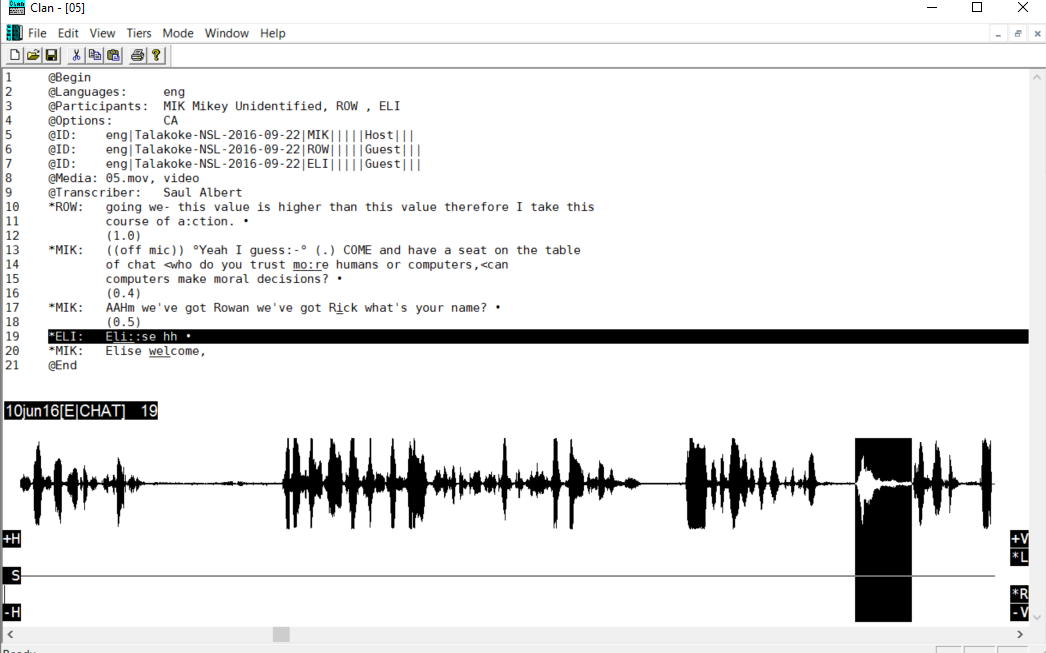
- The ‘List-Turns’ type system represents an interaction such as a Jeffersonian transcript: rendering a lecture turn from turn, a line by line, set semi-diagramatically so that the overlapping lines are vertically aligned on the page.
- The “Timeline Levels” system uses horizontal scrolling skoms such as a video editing interface, multiple layers or “levels” representing EG, a talk of each participant, embedded actions, and other types of action annoted over time.
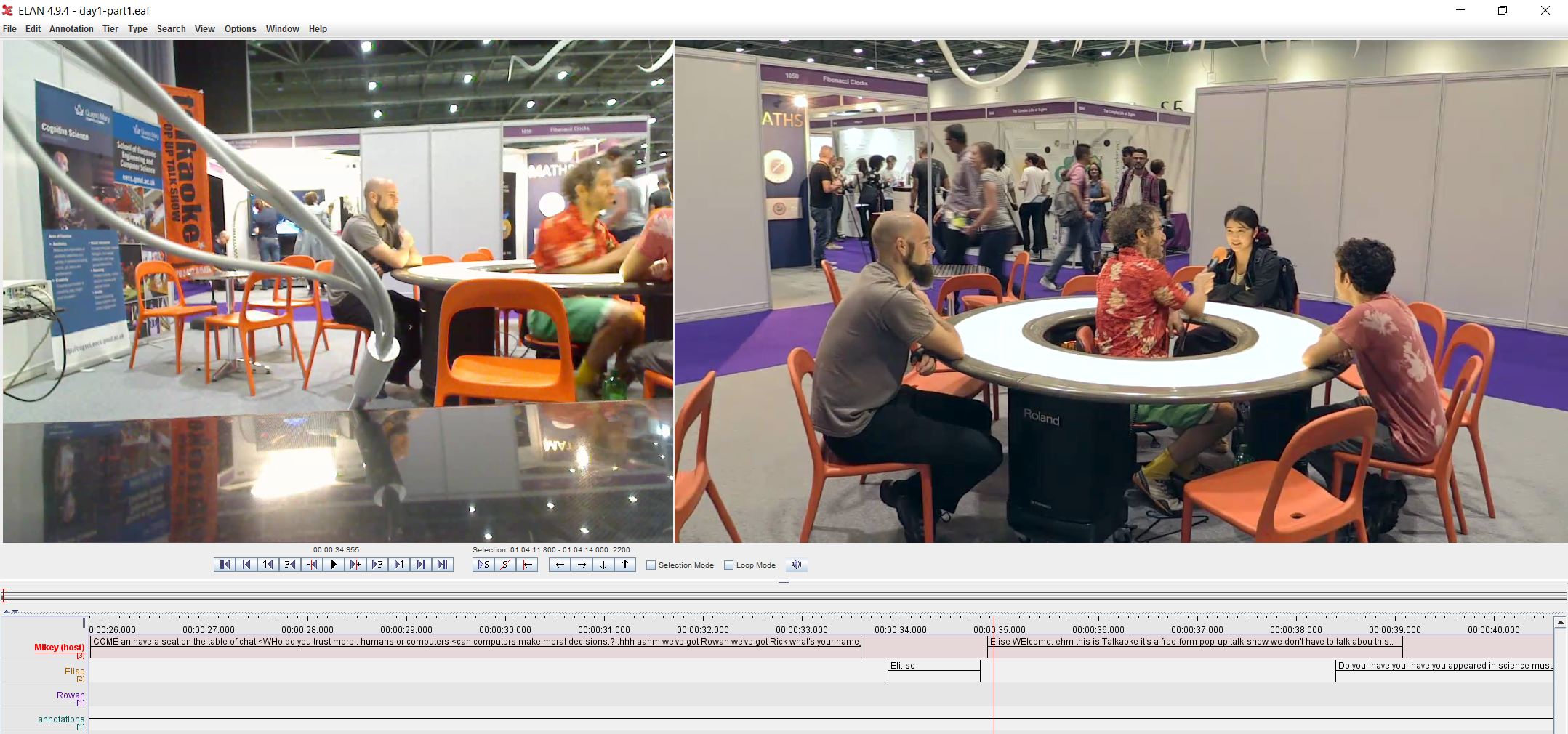
A key utility of the two types of digital transcription systems is that they allow researchers to align media and transcription, and use very precise time tools to check the order and scheduling of their analytical observations.
I used these terms to describe this distinction between a representative scheme in a ‘short expert’ for Alexa Hepburn and Galina Bolden’s excellent book (2017) Transcript to social research entitled “How to choose a conversation analysis transcription software”, where I tried to explain what’s at risk in choosing one system or the other system –
For the most part, researchers choose lists of lists when their analysis is focused on an audible conversation and space, and time levels when their analysis focuses on the body’s visible action video analysis.
The problem for EM / CA researchers working with both approaches, however, is that the representative scheme alone (nor any scheme saves any scheme that may have been constituted through the original interaction itself), is ideal for exploring and description of the processes and resources of the meaning of the meaning of the participants.
The representations of the timetable lines are good for showing the temporal breakdown of simultaneous action, but it is difficult to read more than a few seconds of activity at a glance. In contrast, the lists of turns use the same basic scheme as our well-practiced mundane reading abilities to scan a text page and take the overall structure of conversation, but reduce the time of fine grain and the multi-activity organization of complex embedded activities.
In any case, none of these representative scheme, nor any transcription tools currently available currently capture the dynamics of movement in the way that, for example, specialized graphic methods and life drawing techniques have been developed to achieve (although the prototype of our drawing interactions indicates some possibilities).
The reason I put this digital transcription workshop together was to combine existing and well-used software tools for digital transcript from the two major paradigms, and to show how to work on a piece of data using both approaches. It is not intended as a ‘comprehensive’ solution, and there are many unresolved practical and conceptual issues, but I think it gives researchers the best chance of addressing their empirical concerns to help you get away from the conceptual and disciplinary constraints that come from data analysis using one type, uniform type interface.
Workshop materials include slides (so people can use them to teach collaborators / students) as well as a series of short tutorial videos that accompany any practical exercise in the slides, along with some commentary from me.
My hope is that researchers use and improve these materials, and possibly extend them to include additional tools (eg, EXMARALDA project tool, with which I’m less familiar). If you do, and find ways to improve them with updated tips, hacks, or instructions that consider new versions, please let me know.
Custom Air Products
Pendidikan
Pendidikan
Download Anime
Berita Teknologi
Seputar Teknologi