
The world of college football is much bigger than most people can ever imagine.
Take yourself for example.
Are you aware that two universities in Kazakhstan and Kyrgyzstan have an annual college football game?
Do you watch Canadian college football or Mexican college football?
And how do you feel about the Swedish indoor college football competition being played on the basketball floor?
Yes, college football is a global phenomenon, but perhaps its two most connected national systems are those of the United States and Japan.
Japanese College Football:
I think it’s safe to assume that more Japanese college football fans follow and know American college football than American college football fans follow Japanese college football.
So, there really needs to be no introduction to American college football.
But, for those unfamiliar with Japanese college football, you should understand that it is ingrained in the culture in a similar way.
It is true that most of the games do not even get the attendance of a high school football game, but the attendance of the big games and the importance for the rival alumni of American college football.
College football has been played at elite Japanese universities since the 1930s, and after World War II saw a boom with the Koshien Bowl.
The Koshien Bowl brought with it a national championship with the best teams from the East and the West playing against each other.
This brought pride, and therefore, became an important item in the university calendar like American college football.
American-Japanese connection:
American teams began to notice the passion for the sport and the talent on the field, and therefore, the exhibitions began in the seventies between representative teams of the stars for Japan and singular college football teams from the United States.
Then, college football teams from the United States started a tradition of starting the season in the Coca-Cola Bowl at the Tokyo Dome in the 1980s.

Now, things are more subdued with only some shows still going on like this past spring’s Ivy League All-stars vs. Japan All-stars.
But, one thing has persisted, and that is university partnerships.
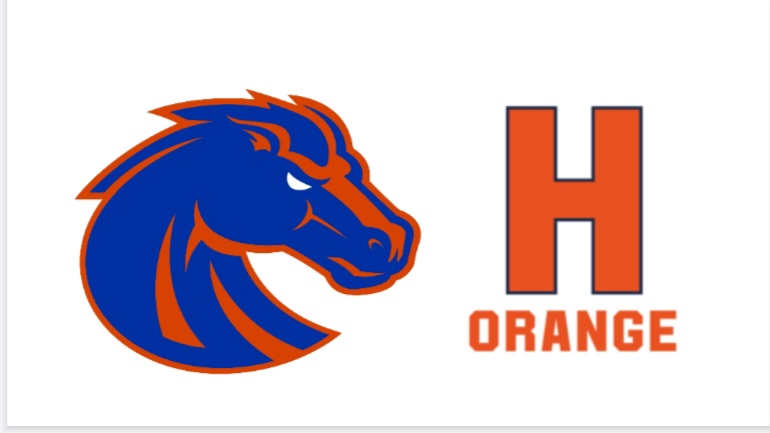
Perhaps the most interesting and most connected partnership is that between Hosei University and Boise State University.
Broncos-Orange partnership:

Since 2007, the Hosei Orange and Boise State Broncos have been facilitating coaching and player exchanges during the spring.
Occasionally, you read about a Bronco playing for Hosei, or watch Hosei’s coaching staff at Albertsons Stadium check in on their favorite American team.
But, you often don’t realize it at first since both schools wear the same colors: orange and blue.
This led to a remarkable occurrence in 2012 when Hosei put the same blue color field that Boise State has. The Broncos had a trademark on the specific field color but encouraged Hosei to expand the blue field brand across the Pacific.

Is 2024 the Year?
Unlike Boise State, Hosei was a top dog before the 2000s with national championships in 1972 and 1997.
But, similar to Boise State, the early 2000s facilitated the brands greatest growth.
The Orange added three more national titles in 2000, 2005, and 2006.
This coincided with Boise State who became synonymous with football in America after their 2006-2007 and 2009-2010 undefeated seasons.
Unfortunately for the Broncos, college football in the United States at the highest level does not have an open access playoff, so Boise State was not included in the most popular and highly regarded national championship game for both seasons.
However, while a request is not made by the university, Boise State can request two national championships from those seasons, which makes many fans and referees neutral. And their creativity and dominance have encouraged their brand to become well respected by football fans everywhere.
Their efforts and efforts of the best sides of the colleges such as TCU, Utah, BYU, and others that have since moved to elite conferences such as UCF and Cincinnati led to the playoff of 12 newly created teams.
The old era of picking two teams or four teams is over, and now the most credible poll and most popular format features 12 teams in its playoff, giving schools from less popular conferences a legitimate shot at a national title.
It’s still not perfect for not every conference champion earns a spot, but it allows passage for at least one lower conference champion.
This year, that conference champion is Boise State, a team that is 12-1, after winning the Mountain West Championship last Friday over UNLV.

The Broncos did so well that they earned a bye in the quarterfinals where they will await the winner of SMU at Penn State to play for the Fiesta Bowl in Glendale, Arizona on December 31st.

Meanwhile, their counterparts across the world’s largest ocean are also taking care of business.
The Hosei Orange finished their regular season 7-1 to win the Kanto College Football Association championship and advance to the Quarterfinals of the Japan Playoffs.
Here, Hosei played against Chukyo University Eagles and won 30-6.

The next round was the Tokyo Bowl Semifinals against the greatest Japanese college football dynasty of all time, the Kwansei Gakuin University Warriors.
The KGU Fighters were then 6x defending national champions and big favourites. If you’re American, think Alabama, North Dakota State, or Mountain Union except even more dominant.
However, Hosei would win on a last second field goal, 20-17.

The Hosei Orange will now play in the 2024 Japanese College Football National Championship (Koshien Bowl) this weekend on Sunday, December 15th against the Ritsumeikan University Panthers, the third best college football team of all time from Japan with 8 national championships.

While neither the Broncos nor the Orange are expected to win their respective national championships, both are on the verge of doing so, paving the way for the other.
For example, when Boise State made their incredible comeback on trick plays to defeat the University of Oklahoma Sooners in the 2007 Fiesta Bowl, then not a playoff game, they gave Hosei’s coaching staff ideas for the next spring season.
Likewise, the Broncos have been influenced by Hosei’s success over the years as well, and the two sets of coaches have communicated on strategies and plays.
This could be the first time that both universities become national football champions in the same season!
And with the Boise State Broncos needing to win the Orange Bowl en route to the CFP Final, it makes the story even better.
For those interested in watching the future games of both teams, here is a schedule:
Hosei Orange:
Koshien Bowl Finals – Sunday, December 15th at 13:05 Hosei local time (Saturday, December 14th at 9:05 PM Boise time)
Boise State Broncos:
Fiesta Bowl Quarterfinal – Tuesday, December 31st at 5:30 PM Boise and local time (Wednesday January 1st at 09:00 Hosei time)
Orange Bowl Semifinals – Thursday, January 9 at 5:30 PM Boise time and 7:30 PM local time (Friday, January 10 at 09:00 PM Hosei time)
CFP Championship Finals – Monday, January 20 at 5:30 PM Boise time and 7:30 PM local time (Tuesday, January 21 at 09:00 PM Hosei time)
Game Center
Agen Togel Terpercaya
Bandar Togel
Sabung Ayam Online
Berita Terkini
Artikel Terbaru
Berita Terbaru
Penerbangan
Berita Politik
Berita Politik
Software
Software Download
Download Aplikasi
Berita Terkini
News
Jasa PBN
Jasa Artikel