

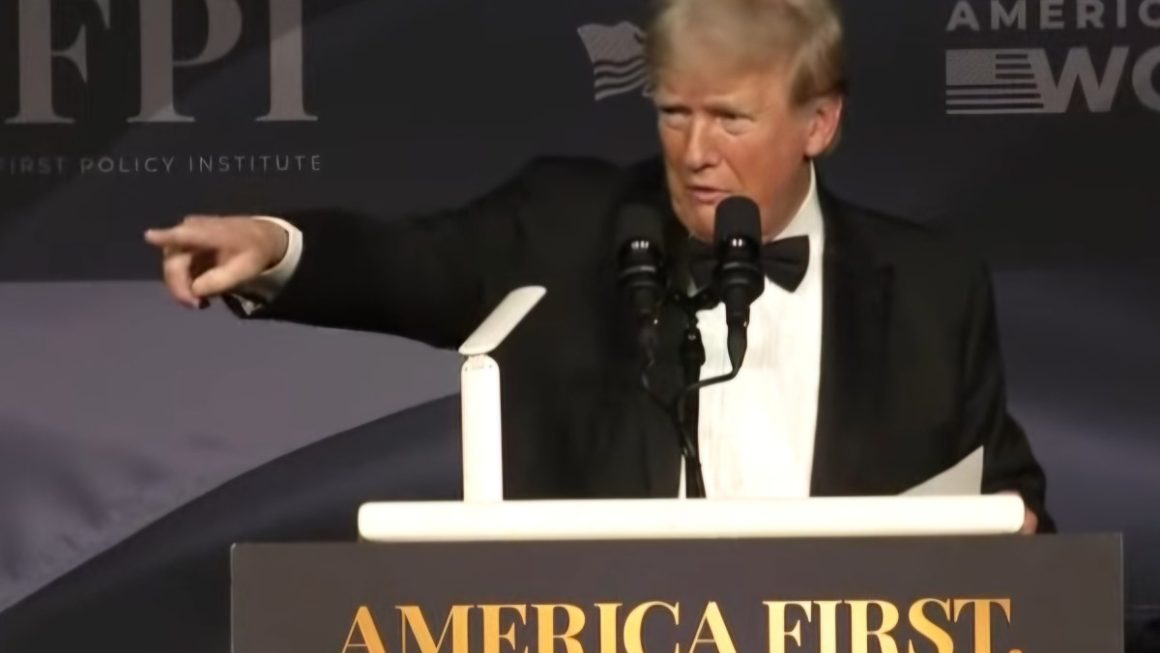
While Western European allies are struggling to accept the election of President Trump, the news from the Pacific and Indian oceans was much better from the pro-American point of view.
The first news of the celebratory victory came from the archipelago nation of Palau, one of the three compact states of free associated states (COFAs). These completely free and sovereign countries are part of the former Trust Territories of the Pacific Islands held under trusteeship by the UN with responsibility to the United States.
Palau, along with the Marshall Islands and the Federated States of Micronesia continue to choose a relationship with their former trust nation that allows the United States to have exclusive military jurisdiction in the now independent nations in exchange for access to many American domestic programs such as sharing the United States Postal Service for example.
The Commonwealth of the Northern Mariana Islands chose to become an American territory instead. Together with Guam, these entities allowed America to operate an area the size of the continental United States.
The relationship between the four nations was close, but not without controversy. One of the most recent controversies has been the rise of mainland China.
Mainland China has become a major economic and military power and their benefits often come with stipulations. One of these was that every Pacific nation no longer recognizes the Republic of China better known as Taiwan.
Another was to replace Western powers such as the United States so that the People’s Republic of China (PRC) would become the main allies.
The COFA nations were not immune to this and Palau was greatly affected.
For example, tourism is a major industry there and mainland China has promised an excess of their citizens to visit Palau in exchange for closer relations and a change of recognition from Taiwan.

The current president, American-born Palaun and Andrews University and UCLA alumnus, Surangel Whipps Jr., has decided to go against blackmail even during the heart of COVID. Not everyone was happy.
Along with these economic and political considerations for change, there were also worries that the Pacific could become a hot bed of military conflict. Therefore, many citizens of these nations tried to distance themselves from their Western alliances so as not to become a military target.
Therefore, when it became known to the wider public that the renewal of the COFA agreement was due in 2023 and 2024, there were debates around every nation. However, fortunately, election results, internal debates, and other factors led back to a renewal on behalf of the three nations.
The only problem remained: the United States.
American legislators dragged their feet to approve the necessary funding for this renewal. Both Republicans and Democrats have often declined on the basis of other political agreements within the bills of these agreements. This led many Pacific commentators to question whether the Americans even valued these alliances.
Therefore, when agreements were finally approved by the United States in March, many wondered how pro-American candidates would fare in the upcoming elections across Oceania.
A vital election was the 2024 Palauan Presidential election.
The former President, Tommy Remengesau, was running against the said President Surangel Whipps Jr.
President Whipps Jr. he advocated for more American military presence and supported various technologies to help the two nations’ defense partnerships, but the Palauan Senate did not always approve.
Therefore, it was a neck and neck election on Tuesday November 5 that President Whipps Jr. won 5,626 votes against 4,103.
This was good news for President-elect Trump and the transition team who are publicly keen to maintain their alliances in the Pacific.


Another controversial center in the Pacific was the Melanesian region where Mainland China almost surpassed the Western powers as the main ally.
However, Papua New Guinea was one country that bucked the trend.
Papua New Guinea is located on the island of New Guinea shared with Indonesia, and has other islands around it.
One of these islands is Bougainville, a place located in the Solomon Archipelago, most of which belongs to the Solomon Islands.
Bougainville is strategically significant because it holds the territorial waters of the Solomon Islands which are now aligned with Mainland China from international waters to the north.
However, Bougainville has its own struggle for independence.
After a Civil War, both Bougainvilleans and Papuans agreed to a future referendum on the issue that the Autonomous Region of Bougainville voted for independence on. The agreement stipulated that their independence should come between 2023 and 2027.


However, no Western power nor anyone else wants to take sides because to do so could risk a future bad relationship with Papua New Guinea or an independent Bougainville.
Until recently, the leadership of Bougainville had remained anonymous as to who it wanted a close alliance with but then decided to give news at the end of last month.
Patrick Winn, a journalist for The World website, wrote that the President of North Bougainville, Ishmael Toroama, has declared that he wants American sponsorship for a new nation and for the United States to help redevelop their rich gold and copper mine.


As a reward, the United States will be allowed to build a new military base in the new nation.
While the Americans have yet to officially respond, it seems the Papuans are not objecting. If this is true, then the two nations will probably land in the Western camp and secure one of the largest Pacific egg.
Finally came the reports from several news companies that President-elect Trump hopes to revoke the agreement that has yet to be formally approved by the Prime Minister of the United Kingdom (UK), Keir Starmer, with the Indian Ocean archipelago nation of Mauritius off the coast of East Africa. The deal will see the UK cede sovereignty over the British Indian Ocean Territory (BIOT) to long-time claimant Mauritius in exchange for a 99-year lease agreement that will see the British and US military retain operational control over the main island: Diego Garcia.
Some commentators have praised this agreement and said that if they do not give up BIOT’s sovereignty, the UK and the Western world will appear legitimate in proceedings with other nations as these other nations such as Russia can assert their claim to part of Ukraine using British control over BIOT as justification. There were other concerns as well and experts said the 99-year deal would allow the West to maintain military control for some time.
However, almost all commentators agreed that the UK losing BIOT made it less powerful and influential.


And, since the agreements of Hong Kong and Macao that slowly eroded, the West are not comfortable to pass the territory in exchange for promises often not kept.
Mauritius has also been more closely linked to the PRC recently, even though the majority of its people are of Indian descent and its religion is pluralistically Hindu.
Due to recent reports of weakening supplies for the American Navy and America’s lack of shipbuilding capabilities compared to their Pacific compatriots, as well as recent issues for the Western world in the Indian Ocean and the Red Sea, it has confused many strategists why a major military ally like the United Kingdom will give up territory.
But, a quick response from many news sources suggested that President Biden’s team strongly suggested this deal.
Now, President-elect Trump hopes to stop this deal from happening.
If the United States can help to keep a large part of the British territory, it will go a long way in warming the relations between the British public and President Trump.


Of course, no one knows the future of North Bougainville or the British Indian Ocean Territory, but the latest developments from the presidential elections of the United States and Palaun have been good for the West in the two oceans where 67% of global trade passes.
Game Center
Agen Togel Terpercaya
Bandar Togel
Sabung Ayam Online
Berita Terkini
Artikel Terbaru
Berita Terbaru
Penerbangan
Berita Politik
Berita Politik
Software
Software Download
Download Aplikasi
Berita Terkini
News
Jasa PBN
Jasa Artikel